
Fruit tree shapes 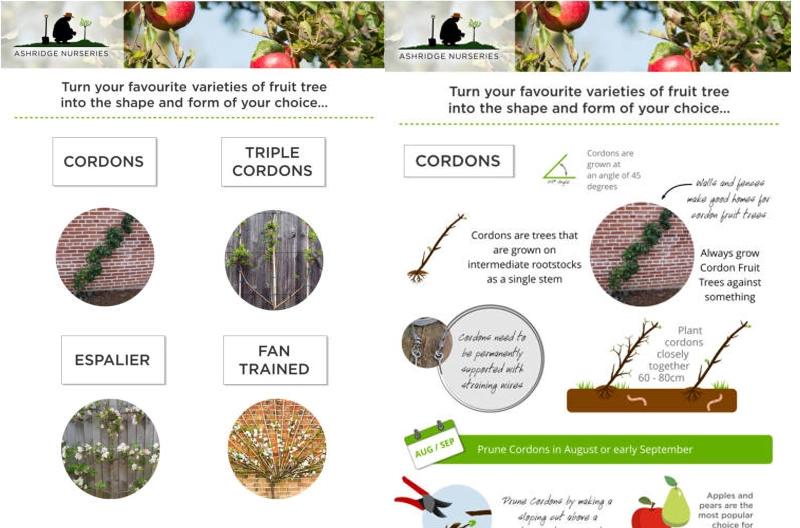
You can grow fruit trees - Apples, Cherries, Damsons, Pears, Plums, Quince - in a variety of shapes, destined to be either freestanding or trained on support wires.
Mini patio fruit trees are a separate category, and the info about sizes and shapes below does not apply to them.
Our Advice:
- For a large, free-standing fruit tree as quickly as possible, start with a Half-standard or a Bush, depending on how much room you have.
- To train your trees on wires (usually against a wall) in a fan or espalier, you must start with a maiden; we sell a selection of popular apple & pear varieties as ready-made cordons, but as long as the variety is spur-bearing you can train them yourself.
- If you only have a small space, or want to grow a fruit tree in a pot, use a dwarf patio tree.
| Shape | Age | Approx Size at delivery | Final Size | Ranges Sold in this Shape | Features |
|---|---|---|---|---|---|
| Maiden |
1 year |
1-2 m |
Any |
All | Cheapest Unbranched Can be grown into any size / shape. Start with a maiden to train fans, espaliers etc on wires. |
| Cordon | 2 years | 90 cm + | 2-3m | Selected Apples & Pears only |
Grown Diagonally. |
| Bush | 2-3 years | 1.5 m | ~3m | Most Popular | Freestanding Tree, trunk under 75cm. Compact, best for most gardens. To about 3m Lower branches for easy harvesting. |
| Half-Standard | 3 years | 1.5 m + | 4m+ | Most Popular |
Freestanding Tree, trunk about 1.25m. |
Almost all our bareroot fruit trees are available as Maidens, which are a finger thick, single stemmed young tree, 1-2m tall when delivered. They were grafted one year ago.
- They will grow into any of the fruit tree shapes that are described below with appropriate pruning.
- For a wire-trained fruit tree like a fan or an espalier, you must start with a maiden (a selection of apple and pear trees are also sold as ready-made cordons).
| Pros | Cons |
|---|---|
| Train a Maiden into any shape you want. | Little trees need longer to establish. |
| Cheapest way to buy fruit trees |
Pruning Videos: You could prune your Maidens in many ways! We show you three classic garden forms: Open Centre Bushes, and Half-Standards, or wire-trained cordons.
Advice
- To prune your own particular style of tree, including fans or espaliers, buy a maiden.
- Maidens save money on planting a whole orchard.
- If you want a few normal, Open Centre garden trees, buy a bush, or a half standard sized tree where available, which are both one year older than a maiden.
Free Standing Fruit Trees
The vast majority of garden fruit trees are grown as either very short trunk "bushes", or low trunk "half-standards". Both are convenient to harvest, the latter is easier to mow under.
Fruit trees grown as bushes
- Bushes at most have a straight trunk of 75cm (2ft 6ins) before they branch, but some stone fruits, such as Damsons, are grown to branch at ground level.
- They crop heavily for their size, are easy to pick, and make the best freestanding fruit trees for a smaller garden or compact orchard.
- Without being miniature, they are a good compromise for a reasonable crop of accessible fruit where space is tight.
- Bushes don't crop as heavily as half standards, and are more difficult to mow underneath. They are accessible to grazing animals.
- Bushes were grafted two years ago.
- Fully grown, they can reach 3.5 x 3 metres, but can be restricted to 2.5 metres.
- Space at least 3.5 metres between trees.
Your bush is well-formed when we deliver it, the first formative pruning has been done for you.
Videos: The two-year-old Open Centre Bush tree that you buy from us, its first year's pruning is for a bush in its second year, and its second year's pruning is a bush in its third year - you are skipping a whole year compared to starting with a maiden.
Bush fruit trees are best for smaller gardens and where use of a ladder is difficult.
| Pros | Cons |
|---|---|
| Ideal size for most gardens. | Might be too big for a very small garden. |
| Crops quickly and heavily. | Not as big a cropper as a half standard |
| Low enough for live stock to chew | |
| Awkward to mow & mulch underneath |
Half standard fruit trees
The biggest size we deliver, the ideal freestanding fruit trees if you have the space. It will arrive about 1.6 metres tall.
- Straight stem of 1.2 metres
- Room for you to mow underneath
- Accommodates our Heavy Duty Tree Guards.
- Main picking height is at 2m, a little over people's heads, taller than most livestock can reach easily.
- Space at least 4 metres between trees.
Our half standard fruit trees have been grown from plants that, depending on the vigour of the variety, were grafted two or three years ago. When fully grown they can reach over 4 x 3 metres, and can be restricted to under 3.5 metres.
| Pros | Cons |
|---|---|
| The fastest way to get a big fruit tree. | Might be too big for a small garden. |
| Perfect size harvesting with a step-ladder | Most expensive |
| Largest crop size | |
| Tall enough for you to get a lawnmower underneath. |
Your half standard is well-formed when we deliver it, the first formative pruning has been done for you.
Videos: The two-year-old Open Centre half standard tree that you buy from us, its first year's pruning is for a half standard in its second year, and its second year's pruning is a half standard in its third year - you are skipping a whole year compared to starting with a maiden.
Our advice:
If you want a nice big fruit tree, and can use stepladders, go for a half-standard: ideal for orchards and larger gardens.
Fruit trees on wires on walls or posts
There are four classic shapes for trained fruit trees: fans are best for stone fruit, but suitable for most fruit trees, and cordons and espaliers best for apples and pears; a step-over is a one-tier espalier.
Cordon fruit trees
Have a range of fruit trees in a restricted area!
Single or multi-stemmed, cordons are typically grown diagonally on support wires. Pruned to create a close framework of stubby fruiting branches, ideal for spur bearing apples and pears, and to some extent plums like Czar.
Cordons are underused! Ideal for growing in small spaces and covering walls and fences; read detailed instructions on how to grow a cordon fruit tree.
- Most apples & pears are spur-bearing and can be used as cordons.
- Some are tip-bearing, these are not suitable for making cordons.
- Space 60cm apart in good soil, 1m apart in poor soil.
- Grow at 45 degrees on wires
| Pros | Cons |
|---|---|
| Save lots of space. | Small final size. Your crop will be about 5-10 kilos. |
| One cordon can be used as a pollinator for a lonely big tree. | Must be grown with support. |
| Cost effective option. | |
| You can grow a row of cordons to get a wide variety of different apples & pears. |
Cordons have a special pruning regime, summer and winter, that helps to keep them restricted; the Modified Lorette System.
Our cordon fruit trees have been grown from plants that were grafted two years ago. When fully grown they will reach 3 metres, but they can be restricted to 2 metres with careful pruning.
Videos: Pruning a Maiden into a Cordon: First year, then Pruning a Cordon.
How to Prune a mature pear espalier (applies to pears & apples)
Fan-trained fruit trees
- Any fruit tree can be fan trained. A maiden is cut down to 60cm (2 ft) in late winter or early spring.
- As the sap rises, between four and six buds below the pruning cut grow into soft and pliable stems that can be trained as the arms of the fan.
- To make more arms, encourage the topmost bud vertical, and cut it back to 20-30cm of new growth the following winter.
If you are in a hurry for a fan, you can buy a bush grown and gently bend/force its branches into a fan shape.
Espalier fruit trees
Espaliers carry fruit on long, wire trained, evenly matched horizontal branches from a central stem. Espaliers are produced from apple and pear maidens:
- Prune the maiden hard in late winter to 10cm (4 inches) above the height of the lowest training wire.
- Young apple trees have hundreds of dormant buds: several buds will break in spring, and the topmost is trained vertical - this central stem will produce all the espalier'd sideshoots.
- Two suitably placed new buds below it are selected as the arms of the first tier. Initially, these two arms are grown at 45 degrees above horizontal until late summer, when they are brought gradually down to the training wires.
- All other shoots should be rubbed out after you are sure you have three viable growths to make the trunk and the 2 arms.
In the second winter, the new vertical leader is cut back to about 10cm (4 inches) above the next horizontal training wire, and the process with choosing two arms is repeated.
A bush fruit tree can be turned into an espalier to save time, but the end result is never quite as satisfying.
A "step-over" fruit tree is simply a single tier espalier that had the leading bud from the first cut rubbed out.
When making an espalier, get all the materials for the wire supports ready in advance, but install the wire after taking some measurements from the plants you receive, to get the lowest wire in the perfect place.
A stepover is simply an espalier shape that keeps only the lowest tier of branches. Just remove the top bud that appears after pruning your maiden to stop the central, upright stem from growing.
Fruit tree arches
It is those cordon grown fruit trees again. Grow them vertically this time, with planting distances of 60-100cms (2-3 feet). Tie them to to a metal or wooden frame to give them shape, and pick fruit as you walk in the shade. Lovely.
Subtitle
Lorem ipsum dolor sit amet, consectetur adipiscing elit. Ut et massa mi. Aliquam in hendrerit urna. Pellentesque sit amet sapien fringilla, mattis ligula consectetur, ultrices mauris. Maecenas vitae mattis tellus. Nullam quis imperdiet augue. Vestibulum auctor ornare leo, non suscipit magna interdum eu. Curabitur pellentesque nibh nibh, at maximus ante fermentum sit amet. Pellentesque commodo lacus at sodales sodales. Quisque sagittis orci ut diam condimentum, vel euismod erat placerat.

Image caption
Lorem ipsum
Lorem ipsum dolor sit amet, consectetur adipiscing elit. Ut et massa mi. Aliquam in hendrerit urna.
Pellentesque sit amet sapien fringilla, mattis ligula consectetur, ultrices mauris. Maecenas vitae mattis tellus.


Lorem ipsum
Lorem ipsum dolor sit amet, consectetur adipiscing elit. Ut et massa mi. Aliquam in hendrerit urna.
Pellentesque sit amet sapien fringilla, mattis ligula consectetur, ultrices mauris. Maecenas vitae mattis tellus.
Lorem ipsum
Lorem ipsum dolor sit amet, consectetur adipiscing elit. Ut et massa mi. Aliquam in hendrerit urna.
Pellentesque sit amet sapien fringilla, mattis ligula consectetur, ultrices mauris. Maecenas vitae mattis tellus.
Lorem ipsum
Lorem ipsum dolor sit amet, consectetur adipiscing elit. Ut et massa mi. Aliquam in hendrerit urna.
Pellentesque sit amet sapien fringilla, mattis ligula consectetur, ultrices mauris. Maecenas vitae mattis tellus.
Subtitle
Lorem ipsum dolor sit amet, consectetur adipiscing elit. Ut et massa mi. Aliquam in hendrerit urna. Pellentesque sit amet sapien fringilla, mattis ligula consectetur, ultrices mauris.