
 1.webp)
 1.webp)
 2.webp)
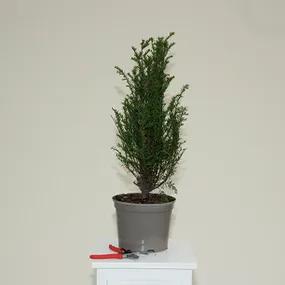
 5.webp)
English Yew Hedging Plants

The details
Taxus baccata
Hedge Plants- Native evergreen.
- Very hardy. Any halfway-well drained soil, any location.
- Perfect formal hedging
- Max. Height: 20m
- RHS Award of Garden Merit
Recommended extras
Description
Taxus Baccata Hedging Plants
Delivered by Mail Order Direct from our Nursery with a Year Guarantee
Common Yew, Taxus baccata, is a native conifer that makes a classic evergreen hedge with a rich, deep green colour that clips beautifully into formal lines, billowing curves and sturdy topiary. Yew is an ideal backdrop to any flower border and it is tough enough to be a roadside hedge. Unlike most other conifers, it will regrow from old wood so it can be hard pruned. It forgives mistakes when clipping, and old, neglected yew hedges can easily be renovated. It is extremely hardy, shade-tolerant and will grow anywhere with decent drainage, reaching about 20 metres if grown as a tree.
The plants on this page are young saplings, ideal for planting as hedging or in woodland projects.
Alternatively, see our full range of hedging.
Yew hedge plants are delivered bareroot during autumn and winter.
Spacing a Yew hedge:
Plant bareroot Yew hedging at 3 plants per metre, 33cm apart. Larger plants can be spaced at 50cm intervals
General description of Yew plants:
Yew has a reputation for being slow growing and this true of mature hedges, which only need clipping once a year. Young Taxus baccata plants are quite vigorous, however. They can easily grow by a metre in under 3 years.
Yew casts dense shade and effectively prevents the growth of other plants underneath it. It is an extremely tough tree; the only thing it won't tolerate is constantly wet soil.
Yew is an unusual conifer because it produces a fruit with a red, berry-like coating around each single seed, instead of a pine-cone that carries a large number of seeds. The red, juicy part of the fruit is called the aril: it is a uniquely adapted reproductive part of a pine cone found in all other conifers, called an ovuliferous scale. The seeds are eaten and dispersed by birds. It is special in another way too: yew trees begin life as males or females, but old trees will produce the occasional stem of the opposite sex. This allows isolated trees to continue making fertile seeds. All parts of the Yew tree are poisonous to humans and almost all animals apart from the red coating of the seeds, but even these should not be eaten: if the seed itself is chewed, it releases paralysing, potentially lethal chemicals.
History & uses of Taxus baccata
Yew is probably the only truly native British tree: no other tree is sure to have been growing here through the last Ice Age. Yew trees live for ages; there are several in Britain that are older than 2000 years, which means that they were centuries old when the Romans invaded in the year 43. The yew trees commonly found in churchyards are often much older than the church itself. Yew's long life is partly due to the strength of the wood and the high toxicity of its living tissues, which seem to be almost immune to disease. One of the noxious poisons derived from the green parts of Yew trees, Taxol, is used in modern medicine to kill cancer cells. Yew's ability to regrow from old wood and its shade-tolerant leaves mean that old trees can regenerate if they are damaged by storms or harvested for wood, even if they are overshadowed by faster growing broadleaf trees.
Yew has been an extremely important resource to humans since before modern Homo sapiens emerged on the scene about 200,000 years ago. The oldest surviving wooden relic from our proto-human ancestors is over 400,000 years old: a spearhead made of Yew. The Yew Longbow was the cornerstone of the medieval English army. Boys, often Welsh conscripts, would be trained from a young age to use the heavy bow, permanently warping the shape of their bodies in the process.
In the age of our animist ancestors, the Yew tree was a god of death and rebirth. It lives for thousands of years, growing in the darkest heart of the forest and on freezing mountain slopes. Old yew trees tend to spread outwards and slump a bit as their heavy branches pull open their centre, often creating a thick, wide evergreen canopy quite close to the ground. As the original, main trunk gradually splits apart and rots away, these low branches can root where they rest on the soil, thus resurrecting. It is easy to imagine clans of Stone Age humans constructing homes under them, perhaps using the long, low, rigid branches as ceiling beams, sheltering from the late Autumn winds and fending off famished bears. The sacred quiet beneath the oldest Yews was a place of reverence. It housed the wizened, gnarled face of the god itself: a massive, brooding creature that did not suffer cold or time. The red flesh of Yew's fruit was a nourishing treasure to our ancestors in winter, but anyone who bit down on the seed inside could have been paralysed and possibly killed, which surely added to the awe that this unique tree inspired.
These "berries" have an interesting flavour and an unfortunately slimy texture, however, it is essential that you spit the seed out without chewing it. If you swallow one by accident, it won't be a problem as long as you didn't bite into it.
Taxus is Latin for Yew, and baccata means to have berries, bacca.
Yew is superb firewood, but it needs to be split and then seasoned for several years before it will burn beautifully.
"He that in winter should behold some of our highest Hills in Surrey, clad with whole woods of these two last sort of trees, yew and box, might without the least violence to his imagination, easily phansie himself transported into some new, or enchanted Country."
John Evelyn, 1662
Planting Instructions
Growing Yew:
Yew will grow well in any soil and any conditions with good drainage.
It is suitable for shade, the coast, chalky soil and very exposed or frosty sites.
Mature yew is drought hardy.
It will not grow well if the site is regularly wet and boggy. Occasional waterlogging seems to be fine; there is a big old Yew tree near us, growing on pretty rocky ground, that gets drowned almost every winter when the little river next to it floods. It has been fine with that for at about 150 - 200 years.
Prepare your site for planting:
Native hedge plants like Yew are very tough. The only essential preparation is to kill the weeds in a strip a metre wide along the planting site: improving the soil should not be necessary.
If your soil is exceptionally poor and dry, then digging in some well-rotted manure and/or compost is worthwhile.
Watch our video on how to plant a garden hedge for full details.
The plants in this video are delivered pot-grown, but planting out bareroot stock is essentially the same.
Remember to water establishing plants during dry weather for at least a year after planting.
Hedge Planting Accessories:
Yew does not need protection from grazing animals: they won't eat it.
Prepare your site for planting by killing the weeds and grass with Neudorff WeedFree Plus.
We always recommend using Rootgrow when planting as it significantly improves establishment and early growth.
After you plant a hedge, the most important thing to do is water it in dry weather. If you didn't use mulch of some kind, you will also need to weed around the hedge. Both of these will be necessary for at least a year after planting.
Like all evergreen plants, Yew is active and using water throughout the year. This means that if the weather is dry in winter, your establishing plants need to be watered.
Trimming Formal hedge plants:
Yew doesn't need any clipping at all in its first year.
From the winter after planting onwards, your young hedge should be trimmed lightly once a year, until it is mature.
When it is fully grown, you can clip it at anytime.
A good time to clip mature Yew hedges is September or early October, because this should let you get away with clipping once per year while maintaining a neat hedge.
Special notes on caring for Yew hedges:
When your new yew hedge is still growing up to the desired height, do not trim the central, leading stem at all. This will make your hedge grow faster. You only need to trim the side branches very lightly to encourage bushy, thick growth.
Yew is a very tough hedge plant that shouldn't need special attention once it has established. If you didn't use a mulch fabric, it is beneficial to mulch around the base of the hedge each year.
Hygiene & Diseases:
Dead, damaged or diseased wood should be pruned off as soon as it appears.
Disinfect your pruning tools between every cut if there is any sign of disease.
Burn or dispose of any diseased material, do not compost it.